What Oscar winners are cut on: 36 years of Hollywood in one video (and everything that went wrong)
I documented which system was used to cut 185 films nominated for the Best Film Editing Oscar since 1990 and turned it into a data video, narrated in three languages by my cloned voice. Step by step.
Contains AI-generated images or voice
Also available in: Spanish · Portuguese
There’s a question I get asked a lot in class: what is real cinema actually cut on? Not a YouTube video, but the films that make it to the Oscars. The answer fits in a minute and a half of video, but getting there took me a lot longer. Here’s the result:
Here’s how I made it, what went wrong at each step and what I’d do differently. This is the first of two pieces: the second looks at the same question from the Internet, with Google Trends, and it has traps of its own.
1. The starting point: the data I wanted doesn’t exist
What I did. The idea came from a popular LinkedIn video: a “bar chart race” of the world’s largest banks by assets, year by year. I wanted to do the same with editing software: how many users each program had each year.
What went wrong. That data doesn’t exist. Adobe stopped publishing subscriber numbers per product, Blackmagic Design (DaVinci Resolve) is a private company and publishes nothing, and Avid was taken off the stock market in 2023, so it doesn’t even report results any more.
Why it matters. When you don’t have the data you want, the temptation is to make up a “reasonable” number. That’s exactly what you must never do in a data video.
Tip. Swap the question for one you can actually measure, and say so on screen. I went for two measures: what the films nominated for the Oscar were cut on (this chapter) and what people search for on Google (the next one).
2. The Oscars, film by film: “no quote, no entry”
What I did. The Best Film Editing Oscar is the only measure that covers the whole period, from 1990 to 2026. Five nominees a year: 185 films. For each one I had to find out what it was cut on, and that isn’t in any database. I used research agents in Claude Code (an AI assistant that works on your computer: it searches, reads pages and saves what it finds) with one strict rule: every row carries the URL of the source and the exact sentence that says it. No quote, no entry. Many sources from the 90s no longer exist, and I recovered them from the Internet Archive, which keeps old copies of web pages.
What went wrong. There are gaps, lots of them. Of the 50 nominees of the 1990s, 22 stayed undocumented, mostly from 1990 to 1993. Between 2000 and 2026, 31 of 135. In total, I know what 132 of the 185 were cut on. And some sources come from the manufacturer itself: the claim that The English Patient (1997) was the first winner edited digitally comes from an Avid press release. That’s why the video says “according to Avid”.
Why. In the 90s nobody thought the editing system was news. From the 2000s on, trade magazines (Post Magazine, CineMontage, CGW) almost always mention it, because it became a selling point.
Tip. Leave the gaps visible. In the video, the percentages are of the films documented at each moment (with a three-ceremony window so they don’t jump from one year to the next), and while there isn’t enough data a sign says so: “No documented nominees yet”. And when the only source is the brand, say it.
3. What came out: from scissors to a single editing desk

With clean data, the story tells itself:
- 1990–1992: celluloid. In those ceremonies, at least 85% of the documented nominees were cut on film.
- 1995: digital arrives, but not the one everybody expected. Pulp Fiction is nominated, and it was cut on Lightworks.
- 1997: Avid. The English Patient, edited by Walter Murch, wins (according to Avid, the first digital winner).
- 2004: Final Cut. Murch himself cuts Cold Mountain on Final Cut Pro, and Post Magazine calls it the first major Hollywood picture edited on it. In 2011 The Social Network wins with Final Cut.
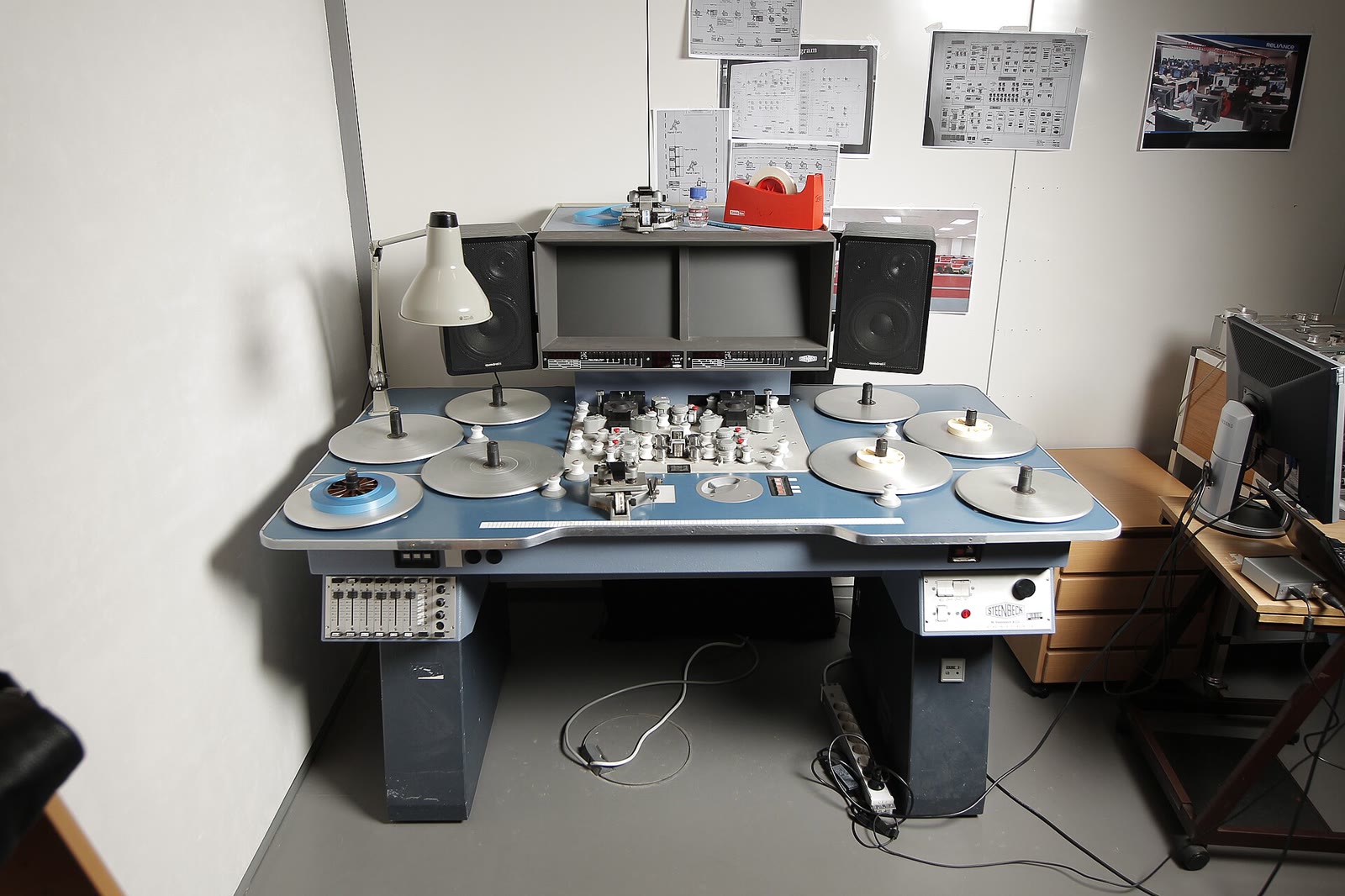
- 2006: the exception. Michael Kahn is still cutting film on a Moviola for Munich, in a truck turned into an editing room.
- 2014–2019: unanimity. All 30 documented nominees of those six ceremonies were cut on Avid. Thirty out of thirty.
- 2023 and 2025: Premiere wins twice. Everything Everywhere All at Once and Anora, which its director, Sean Baker, edited himself.

In amber you see what was happening outside Hollywood, because it helps make sense of the rest: Adobe Premiere 1.0 for $495 (1991), Media 100 (1993), the Targa 2000 card with Premiere for $5,995 (1994) and Final Cut Pro 1.0 for $999 (1999). Cinema and the desktop were on different roads.
The closing figure sums it up: between 2004 and 2026, 84% of the documented nominees (77 of 92) were cut on Avid.
4. The design: three attempts
What I tried first. Since the subject is editing, I drew each program as a track on a timeline, with the waveform as thick as its share. That’s design 1 in the clip below.
What went wrong. It looked nice and you couldn’t read it: with stacked tracks you can’t see who’s in the lead, which is the only thing that matters in a race.
What worked. I switched to audio level meters, like the ones on a mixing desk: the biggest one rises to the top, the percentage updates live and, if one goes off the scale, the red clip light comes on. That’s design 2. Compare them at the same moment (the prototypes are in Spanish):
The third attempt was about pace. The first version with meters lasted 18 seconds and there was no time to read anything. The final one moves at 0.6 seconds per year and the playhead never stops completely: while a sentence is being spoken it keeps drifting slowly, so the meters never freeze.
A technical failure with a lesson. When I slowed it down, some rows got stuck halfway through swapping places: the swap was measured in years of data, not in seconds of video, and when the clock slowed down it was left halfway. The fix was to time every transition in video time.
Tip. In a data video, everything you see should depend on a single clock. That way you can jump to any frame and it always looks the same, which is what a render needs.
The video is built with HyperFrames, an open-source tool by HeyGen that turns an animated web page into video, frame by frame.
5. The voice: mine, cloned, in three languages
What I did. The narration is my voice, cloned with Voicebox, a free app that clones a voice on your own computer, without uploading it anywhere. The script doesn’t read the screen: figures and names are already written, so the voice adds the intention (“And then, silence. Six years in which everything runs through the same editing bay”). I checked every sentence with whisper.cpp, a transcriber that runs locally: if Whisper can’t understand a sentence, neither will a viewer.
What went wrong (1): English names. The clone reads what it sees, and in the Spanish version “Murch” sounded Spanish. In the text sent to the engine I spell them out as they sound (“Uólter Merch”, “Máikel Kan”); nothing changes on screen.
What went wrong (2): the English and Portuguese versions. The easy way was to dub the Spanish video with a dubbing tool. I didn’t, for two reasons: those tools replace the whole soundtrack (you lose the music) and leave the on-screen text in Spanish. So I generated each language from the project: translated captions, a new voice, and every section’s length adjusting itself to the length of each sentence.
What went wrong (3): numbers. In English, the voice said “1990” in Spanish. The voice profile is Spanish and reads numbers its own way. Whisper didn’t catch it: it writes “1990” whatever language it’s said in. I caught it by listening. The fix is to write numbers out in words, only for the engine (“nineteen ninety”). And in Portuguese there was one word, “ousou”, the clone couldn’t say; I replaced it with a synonym (“se atreveu a”).
Tip. Check with a machine, but listen to every language yourself at least once.
The label. Because the voice is synthetic, the video carries from the very first frame the European Union’s official icon for AI-generated content, with the text “AI-generated voice, cloned from Jorge Mochón’s”. It’s been mandatory since 2 August 2026 (Article 50 of the AI Act). The music is an Adobe Stock track under a standard license; it ducks automatically while I speak and comes back up between sentences.
If you want to try it
- Before designing anything, check the data exists. If it doesn’t, change the question and say so on screen.
- One row, one source, one exact quote. What can’t be quoted doesn’t go in.
- Work out percentages on what’s documented, and show the gaps.
- Try at least two designs and look at them side by side at the same moment.
- Pace: slower than you think. 0.6 seconds per year worked.
- Cloned voice: foreign names and numbers written as they’re pronounced, a Whisper check, and a human listen in every language.
- An AI label, visible from the very first frame.
Everything you see in this video is motion graphics: captions, meters, a time ruler and a moving playhead. If you want to learn to animate information like this, with rhythm and readability, that’s what we work on in the Motion Graphics course.
Get these tests once a month in your inbox: join the newsletter.